
Top 10 Magnetic Pulley Manufacturers in the World
Are you an industrial procurement manager or plant engineer struggling to source verified magnetic pulley systems that guarantee continuous ferrous removal without halting your production line? In 2026, finding reliable magnetic head pulley manufacturers is increasingly difficult. Many buyers waste weeks screening companies that are merely general magnet producers, rather than dedicated engineers of heavy-duty conveyor separation systems. Recurring sourcing headaches include inconsistent magnetic field penetration, premature bearing failure due to shaft misalignment, uncertified welds on the pulley shell, and inefficient magnetic circuits that allow tramp iron to escape.
_1786699087_WNo_1600d900.webp)
Curated through verified factory audits, mineral processing case studies, and mainstream OEM cooperative credentials, our 2026 ranking of the Top 10 Global Magnetic Separator Manufacturers for magnetic pulleys filters out unqualified suppliers. Whether your application requires heavy-duty mining head pulleys, high-intensity rare-earth separator pulleys, or custom conveyor magnetic systems, this guide will help you lock in dependable partners and slash procurement risks.
Manufacturer Comparison Table
Before diving into the detailed company profiles, use this quick comparison table to evaluate the core capabilities of the leading magnetic pulley suppliers.
| Manufacturer | Country | Magnetic Pulley | Head Pulley | Rare Earth | Custom Design | Main Applications |
|---|---|---|---|---|---|---|
| USA | ✓ | ✓ | ✓ | ✓ | Recycling, Mining, Aggregate | |
| STEINERT | Germany | ✓ | ✓ | ✓ | ✓ | Mining, Scrap Metal, Waste |
| Bunting Magnetics | USA/UK | ✓ | ✓ | ✓ | ✓ | Recycling, Plastics, Conveying |
| Goudsmit Magnetics | Netherlands | ✓ | ✓ | ✓ | ✓ | Recycling, Bulk, Food |
| MSI | USA | ✓ | ✓ | ✓ | ✓ | Mining, Aggregate |
| IMI | USA | ✓ | ✓ | ✓ | ✓ | Heavy Industry, Stamping |
| Shields Magnetics | USA | ✓ | ✓ | ✓ | ✓ | Plastics, Grain, Bulk |
| PML | India | ✓ | ✓ | ✓ | ✓ | Mining, Ceramics, Chemicals |
| Star Trace | India | ✓ | ✓ | ✓ | ✓ | Mineral Processing, Sand |
| Lodestone | USA | ✓ | ✓ | ✓ | ✓ | Aggregate, Construction |
How We Ranked Magnetic Pulley Manufacturers
To ensure our list meets the rigorous standards of Google's E-E-A-T guidelines, our evaluation is based on product relevance and publicly available company information, rather than unverified global market share. The ranking criteria include:
- Magnetic Pulley Product Relevance (30%): Depth of focus on magnetic head pulleys versus general magnet production.
- Manufacturing Capability (20%): In-house CNC machining, balancing, and heavy-duty welding capabilities.
- Product Range (15%): Availability of Ceramic, Rare Earth, and Electromagnetic variants.
- Customization Capability (15%): Ability to engineer custom shafts, diameters, and lagging to match specific conveyors.
- Industry Experience (10%): Proven field applications in demanding environments like mining and scrap yards.
- Global Market Reach (10%): Established distribution and after-sales support network.
Product information was reviewed from the manufacturer's official website and product documentation to ensure accuracy.
Table of Contents
- 2. STEINERT GmbH
- 3. Bunting Magnetics
- 4. Goudsmit Magnetics
- 5. Magnetic Systems International (MSI)
- 6. Industrial Magnetics, Inc. (IMI)
- 7. Shields Magnetics
- 8. Permanent Magnets Ltd. (PML)
- 9. Star Trace Solutions
- 10. Lodestone Fabrication
- What Is a Magnetic Pulley?
- How Does a Magnetic Pulley Work?
- How to Choose the Right Magnetic Pulley
- How Much Does a Magnetic Pulley Cost?
- Product Comparisons
- How to Choose a Magnetic Pulley Manufacturer
- FAQ
2. STEINERT GmbH
Company Overview: Founded in 1889 and based in Cologne, Germany, STEINERT is a pioneer in sensor sorting and heavy-duty magnetic separation. Their engineering represents the pinnacle of German manufacturing precision.
Magnetic Pulley Products: The STEINERT BRP Flex is their flagship magnetic pulley, designed for adaptable integration into existing conveyor systems. They also manufacture universal magnetic head pulleys.
Technical Capabilities:
- Diameter: 300mm to 1,500mm.
- Magnetic Field Strength: Up to 12,000 Gauss on the surface using high-grade NdFeB.
- Magnet Type: Rare Earth and Ceramic, with customizable pole configurations.
- Customization: Engineered to specific belt speeds and burden depths.
Applications: Iron ore concentration, scrap metal recovery, e-waste recycling, and incinerator bottom ash processing.
Why Consider This Manufacturer: STEINERT provides ultra-precise magnetic circuits capable of recovering weakly magnetic stainless steels. They are ideal for operations where maximum purity is the absolute priority.
3. Bunting Magnetics
Company Overview: Headquartered in Newton, Kansas, USA (with major operations in the UK), Bunting is a leading magnetic pulley supplier focusing on recycling and food processing. They engineer both the magnetic assemblies and the final pulley housing in-house.
Magnetic Pulley Products: Bunting offers a wide range of Permanent Magnetic Pulleys, available in standard and high-intensity Rare Earth models.
Technical Capabilities:
- Diameter: 8 to 36 inches.
- Magnet Type: Ceramic (Ferrite) for large tramp iron, Rare Earth for fine ferrous.
- Shaft Configuration: Tapered, hexagonal, or keyed shafts to match OEM conveyor designs.
- Lagging: Available with heavy-duty vulcanized rubber lagging.
Applications: Plastics recycling, tire recycling, grain processing, and general bulk material conveying.
Why Consider This Manufacturer: Bunting excels in providing custom-engineered solutions with fast lead times. They are highly recommended for processors who need specific dimensional adaptations to retrofit existing conveyors.
4. Goudsmit Magnetics
Company Overview: Based in Waalre, Netherlands, Goudsmit Magnetics is a family-owned business known for innovative, clean European design. They focus heavily on hygiene, ease of cleaning, and magnetic field optimization.
Magnetic Pulley Products: They manufacture high-gradient Magnetic Head Pulleys featuring their proprietary Neoflux® (NdFeB) magnetic circuits.
Technical Capabilities:
- Diameter: 100mm to 600mm+.
- Belt Width: Custom matched to client specifications.
- Magnet Type: High-intensity Rare Earth (Neoflux®).
- Material: Fully welded 304/316 stainless steel shells for sanitary applications.
Applications: Food and beverage processing, pharmaceutical powders, and high-end plastic recycling.
Why Consider This Manufacturer: Goudsmit is the top choice for industries where hygiene and weakly magnetic stainless-steel removal are critical. Their Neoflux® technology guarantees long-term magnetic strength without degradation.
5. Magnetic Systems International (MSI)
Company Overview: Headquartered in the USA, MSI is a specialized manufacturer focused on heavy-duty industrial magnetic equipment for the mining and aggregate sectors. They are recognized as a rugged industrial magnetic pulley manufacturer.
Magnetic Pulley Products: MSI manufactures "Ferrous Pulleys" and standard magnetic head pulleys designed for severe duty applications.
Technical Capabilities:
- Diameter: 12 to 60 inches, capable of handling massive tonnages.
- Magnet Type: Heavy-duty Ceramic and Rare Earth configurations.
- Shaft Configuration: Oversized, heat-treated steel shafts to prevent deflection under heavy loads.
- Lagging: Extreme-duty rubber or ceramic lagging available.
Applications: Hard rock mining, coal preparation plants, and construction aggregate processing.
Why Consider This Manufacturer: MSI builds equipment that survives the harshest environments. If your operation involves moving hundreds of tons of abrasive rock per hour, MSI provides uncompromising durability.
6. Industrial Magnetics, Inc. (IMI)
Company Overview: Based in the USA, IMI is a comprehensive magnetic separator manufacturer known for their robust engineering and extensive inventory of standard magnetic products.
Magnetic Pulley Products: IMI offers a wide array of Magnetic Head Pulleys under their "Round Pulley" and "Square Pulley" configurations.
Technical Capabilities:
- Diameter: 6 to 36 inches.
- Magnet Type: Rare Earth and Ceramic.
- Magnetic Field Strength: Deep-reach magnetic fields designed to penetrate deep burden depths.
- Customization: Standard and custom shafts available for immediate retrofit.
Applications: Heavy industry, metal stamping facilities, scrap yards, and bulk material handling.
Why Consider This Manufacturer: IMI is highly reliable for B2B clients needing fast delivery of standard sizes. Their pulleys are heavily over-engineered for long service life in industrial manufacturing.
7. Shields Magnetics
Company Overview: A US-based manufacturer, Shields Magnetics focuses on permanent magnetic separation equipment for lighter-duty and medium-duty industrial applications.
Magnetic Pulley Products: They provide standard Magnetic Head Pulleys designed to replace standard conveyor drive pulleys seamlessly.
Technical Capabilities:
- Diameter: 4 to 24 inches.
- Magnet Type: Ceramic and Rare Earth.
- Shaft Configuration: Standard keyed shafts.
- Features: Available with crowning to aid belt tracking.
Applications: Plastics extrusion lines, grain handling, and lightweight bulk material conveying.
Why Consider This Manufacturer: Shields Magnetics is a cost-effective magnetic pulley supplier for operations that do not require the massive tonnage capacity of heavy-duty mining manufacturers.
8. Permanent Magnets Ltd. (PML)
Company Overview: Headquartered in India, PML is a major manufacturer of permanent permanent magnets and magnetic separation equipment, serving global markets with competitive pricing.
Magnetic Pulley Products: PML manufactures both Magnetic Pulleys and Magnetic Head Pulleys using in-house produced ferrite and NdFeB magnets.
Technical Capabilities:
- Diameter: 200mm to 1,200mm.
- Belt Width: Up to 1,600mm.
- Magnet Type: Rare Earth and Ceramic.
- Customization: High flexibility for OEM specifications.
Applications: Mining, ceramics, glass raw material purification, and chemical processing.
Why Consider This Manufacturer: PML offers excellent value, combining decent heavy-duty engineering with the cost advantages of Indian manufacturing. They are ideal for budget-conscious mining operations.
9. Star Trace Solutions
Company Overview: Based in India, Star Trace is a well-known manufacturer and supplier of processing equipment, particularly focused on mineral and sand washing circuits.
Magnetic Pulley Products: They specialize in Permanent Magnetic Pulleys designed for continuous separation in wet and dry mineral processing.
Technical Capabilities:
- Diameter: 300mm to 1,500mm.
- Magnet Type: High-intensity Rare Earth.
- Material: SS304 or SS316 shells for corrosion resistance.
- Shaft Configuration: Custom engineered for heavy conveyor tensions.
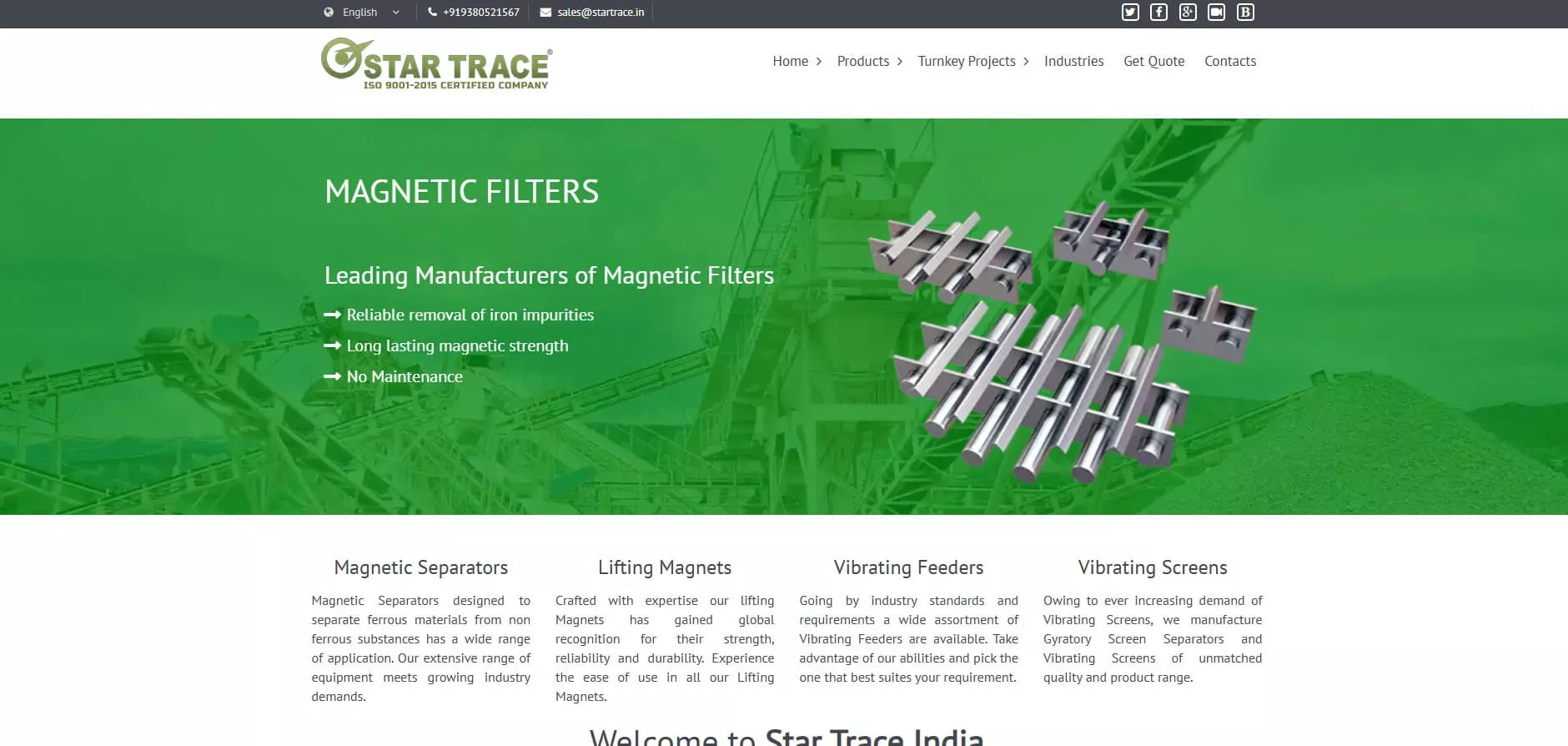
Applications: Mineral sands processing, silica sand purification, and iron ore beneficiation.
Why Consider This Manufacturer: Star Trace is highly experienced in mineral processing circuits. They are a strong partner for plants needing complete integration of magnetic pulleys into washing and screening systems.
10. Lodestone Fabrication
Company Overview: A US-based fabricator, Lodestone focuses on robust, custom-built magnetic equipment for the aggregate and construction industries.
Magnetic Pulley Products: They manufacture heavy-duty Magnetic Head Pulleys built to withstand severe impact and abrasive environments.
Technical Capabilities:
- Diameter: 12 to 48 inches.
- Magnet Type: Ceramic and Rare Earth.
- Features: Heavy-gauge steel shells, abrasion-resistant wear plates.
- Customization: Full custom fabrication to match specific conveyor stringers.

Applications: Aggregate crushing lines, construction & demolition (C&D) waste recycling.
Why Consider This Manufacturer: Lodestone is the go-to fabricator for quarry operators who need bullet-proof, easily repairable magnetic pulleys that can survive primary crushing environments.
What Is a Magnetic Pulley?
A magnetic pulley (also known as a magnetic head pulley) is a type of conveyor pulley that incorporates a permanent or electromagnetic magnetic system. It is installed at the head (discharge end) of a conveyor belt to attract and automatically remove ferrous materials as the conveyed material passes over the pulley.
Key Structural Components:
- Magnetic Field Generator: Stationary internal array of permanent magnets (NdFeB/Ferrite) or an electromagnetic coil.
- Conveyor Belt: The standard belt that transports the bulk material.
- Pulley Shell: A rotating non-magnetic stainless steel cylinder that encases the magnetic array.
- Shaft: The fixed central shaft around which the shell rotates, supported by bearings.
- Lagging: Optional rubber or ceramic coating on the shell to increase friction and prevent belt slippage.
Unlike standard conveyor pulleys, a magnetic pulley actively sorts the material stream, separating ferrous metals from non-ferrous materials.
How Does a Magnetic Pulley Work?
Understanding the magnetic pulley working principle is crucial for optimizing your separation circuit. The process operates continuously in 4 distinct steps:
- Step 1: Material Conveyance - Bulk material (e.g., sand, grain, or crushed ore) is fed onto the conveyor belt and transported toward the discharge end.
- Step 2: Entering the Magnetic Field - As the material reaches the magnetic head pulley, it enters a dense magnetic field generated by the stationary internal magnet array.
- Step 3: Magnetic Attraction - Ferrous materials within the burden are attracted toward the pulley surface and held firmly against the underside of the conveyor belt.
- Step 4: Trajectory Separation - Non-magnetic material follows a normal natural trajectory and is discharged into the primary bin. The ferrous material is held tightly to the belt until it passes beyond the magnetic field's influence (usually 180 degrees from the top), where it drops into a separate reject bin.
How to Choose the Right Magnetic Pulley
Selecting the correct magnetic pulley requires evaluating your specific conveyor parameters and material characteristics. Follow this engineering guide:
1. Conveyor Belt Width
The magnetic pulley must be wider than the conveyor belt to ensure full magnetic coverage. Standard belt widths include 400mm, 600mm, 800mm, 1000mm, 1200mm, and 1400mm+. Always match the pulley face width to the belt width specifications.
2. Pulley Diameter
Diameter affects belt wrap angle, belt speed, and magnetic exposure time. Larger diameters provide a larger magnetic contact area, improving separation efficiency for high-tonnage applications. Common diameters range from 12 inches (300mm) to 48 inches (1200mm).
3. Magnet Type
Choosing the right magnet type dictates separation power and cost:
| Magnet Type | Strength | Cost | Typical Application |
|---|---|---|---|
| Ceramic (Ferrite) | Medium | Lower | General ferrous separation, large tramp iron |
| Rare Earth (NdFeB) | High | Higher | Fine ferrous recovery, weakly magnetic steels |
| Electromagnetic | Adjustable | Higher | Heavy-duty applications requiring deep field penetration |
If you need a custom magnetic pulley, consult with an OEM manufacturer like Mag Spring to optimize the magnetic circuit for your specific burden depth.
How Much Does a Magnetic Pulley Cost?
The cost of a magnetic pulley varies dramatically based on engineering requirements. Rather than offering a fixed price, it is important to understand the cost drivers:
- Pulley Diameter & Belt Width: Larger dimensions require more steel and more magnetic material, increasing cost exponentially.
- Magnet Type: Rare Earth (NdFeB) pulleys cost significantly more than Ceramic pulleys but offer 3x the magnetic strength.
- Magnetic Strength: Higher Gauss ratings require denser magnetic arrays.
- Pulley Material: Standard carbon steel is cheaper; 304/316 stainless steel shells add cost but prevent magnetic shunting and corrosion.
- Lagging & Shaft Design: Custom rubber lagging, oversized shafts, and specialized keyways increase machining costs.
- Production Volume: OEM bulk orders will significantly reduce the per-unit cost.
To get an accurate quote, you must provide the manufacturer with your belt width, required diameter, shaft specifications, and the type of material you are processing.
Product Comparisons
Understanding how a magnetic pulley compares to other separation equipment ensures you choose the right tool for the job.
Magnetic Pulley vs. Overband Magnetic Separator
| Feature | Magnetic Pulley | Overband Magnet |
|---|---|---|
| Installation | Replaces conveyor head pulley | Suspended above the conveyor |
| Separation | Continuous, at the discharge point | Continuous, over the belt surface |
| Space | Low, requires no extra headroom | Requires overhead space for suspension |
| Belt Replacement | Relatively simple (conveyor belt) | Requires separate belt system maintenance |
| Typical use | Head pulley separation | High-volume deep burden ferrous removal |
Permanent Magnetic Pulley vs. Electromagnetic Pulley
A permanent magnetic pulley uses NdFeB or Ferrite magnets, requires no external power, and is safer in explosive environments. An electromagnetic pulley requires a DC power supply to generate the field but allows the operator to adjust the magnetic strength or turn it off completely to release the ferrous material, which is useful for sorting heavy scrap.
How to Choose a Magnetic Pulley Manufacturer
When evaluating magnetic pulley manufacturers, use this checklist to ensure you are partnering with a true OEM rather than a trading company:
- Product Capability: Do they engineer the magnetic circuit in-house, or do they just buy standard magnets and machine the steel?
- Engineering Capability: Can they support custom diameters, custom widths, specific shafts, and bespoke magnet configurations?
- Material & Magnet Quality: Do they use high-grade Neodymium (NdFeB) or low-grade recycled magnetic materials? Is the shell made of non-magnetic stainless steel?
- Manufacturing Capability: Do they have in-house CNC machining, dynamic balancing equipment, and professional welding for the pulley shell?
- After-Sales Support: Do they provide installation support, spare parts (bearings, shafts), and technical documentation?
FAQ: Magnetic Pulley Sourcing Guide
Q1: What is the difference between a magnetic pulley and a magnetic head pulley?
They are generally the same thing. "Magnetic head pulley" specifically refers to its installation location (the head/discharge end of the conveyor), while "magnetic pulley" is the broader term for the component itself.
Q2: What type of magnet is used in a magnetic pulley?
Most modern high-efficiency pulleys use Rare Earth (Neodymium Iron Boron - NdFeB) magnets. However, for large tramp iron removal in mining, Ceramic (Ferrite) magnets are still widely used due to their lower cost and high resistance to demagnetization.
Q3: How strong should a magnetic pulley be?
For fine ferrous removal, the surface magnetic field should be between 3,000 to 5,000 Gauss. For weakly magnetic stainless steel or very fine powders, high-intensity Rare Earth pulleys reaching 8,000 to 12,000 Gauss are required.
Q4: Can a magnetic pulley be customized?
Yes. Top manufacturers can customize the diameter, face width, shaft diameter, shaft length, keyway size, and add rubber lagging to match your exact conveyor specifications.
Q5: What belt width is suitable for a magnetic pulley?
The pulley face width should be at least 50mm to 100mm wider than the conveyor belt width to prevent material spillage over the edges and ensure proper belt tracking.
Q6: How much does a magnetic pulley cost?
A small standard ceramic pulley might cost a few hundred dollars, while a large, custom-engineered Rare Earth magnetic head pulley for mining can cost several thousand dollars. The cost depends heavily on the size and magnet grade.
Q7: What industries use magnetic pulleys?
They are heavily used in mining (iron ore, coal), recycling (plastics, tires, e-waste), aggregate processing, food and grain handling, and chemical manufacturing.
Q8: How long does a magnetic pulley last?
A high-quality permanent magnetic pulley can last 10 to 20 years. The permanent magnets themselves do not degrade if kept below their maximum operating temperature. The mechanical components (bearings, belt) will require standard maintenance.
Q9: How do I choose the right magnetic pulley manufacturer?
Choose a manufacturer that has in-house CNC machining capabilities, offers dynamic balancing for high-speed conveyors, and provides clear technical drawings and Gauss ratings before purchase.
Conclusion
Sourcing the right magnetic separation equipment in 2026 requires navigating a market flooded with generic magnet producers. By focusing exclusively on verified magnetic pulley manufacturers that engineer complete conveyor head pulley systems, you protect your downstream equipment, ensure product purity, and optimize your processing plant's ROI. The 10 global leaders listed above represent the highest echelon of the industry.
When evaluating these suppliers, consider not just the upfront cost, but the magnetic circuit design, ease of cleaning, wear resistance, and compliance certifications relevant to your specific industry. If you need a highly customized, fast-turnaround OEM solution, do not forget to explore our Editor's Choice, Mag Spring, who offers specialized magnetic assemblies and magnetic grates engineered to your exact specifications with worldwide delivery.
