
Top 10 Magnetic Drum Separator Manufacturers in the World 2026
_1787043867_WNo_1600d900.webp)
Selecting the right magnetic drum separator is critical for operations requiring continuous, high-volume ferrous metal separation. Whether you are processing mineral slurries, dry bulk aggregates, or recyclable scrap, a reliable magnetic drum protects downstream equipment and purifies product streams. However, choosing between wet and dry configurations, rare-earth and electromagnetic designs, and matching drum dimensions to your throughput capacity can be a complex engineering challenge.
To help you make an informed procurement decision, this 2026 guide goes beyond a simple manufacturer list. We have structured this page as a comprehensive Technical & Buyer Guide, covering working principles, separator types, cost factors, and a curated list of the Top 10 Magnetic Drum Separator Manufacturers in the World—connecting you directly with engineering-grade factories capable of custom builds.
The List of magnetic drum separator Brands in the World
| No. | Company Name | Magnetic Drum Separator Product Highlights |
|---|---|---|
| 1 | MAG SPRING | Custom Magnetic Drum Separators with flexible magnetic configurations for continuous ferrous-metal removal. |
| 2 | STEINERT | Heavy-duty Magnetic Drum Separators engineered for demanding recycling, mining, and resource-recovery applications. |
| 3 | Goudsmit Magnetics | Hygienic Magnetic Drum Separators designed for efficient ferrous removal from powders, granulates, and bulk materials. |
| 4 | Bunting Magnetics | Ferrite and rare-earth Magnetic Drum Separators offering flexible configurations for recycling and industrial processing. |
| 5 | Metso | LIMS drum separator solutions designed for high-capacity wet and dry mineral-processing applications. |
| 6 | Nippon Magnetics | Specialized Magnetic Drum Separators covering permanent, electromagnetic, housed, and high-intensity configurations. |
| 7 | IFE Aufbereitungstechnik | Radial- and axial-field Magnetic Drum Separators engineered for customized bulk-material and recycling applications. |
| 8 | Multotec | Wet drum Magnetic Separator solutions optimized for dense-media recovery, magnetite recovery, and mineral processing. |
| 9 | Dings Co. Magnetic Group | Durable Magnetic Drum Separators featuring Dings Flux Control technology for deep and consistent ferrous separation. |
| 10 | Malvern Engineering Works | Rugged wet and dry Magnetic Drum Separators developed for mining, dense-media recovery, and mineral processing. |
1. MAG SPRING
_1788320382_WNo_900d429.webp)
Founded: 2003
Headquarters: Ningbo, Zhejiang, China
Main Magnetic Drum Separator Products: 8000GS Electrical Drum Magnetic Separator, Self Cleaning Magnetic Drum Separator
Company Overview: Founded in 2003, MAG SPRING is a China-based manufacturer of permanent magnets and industrial magnetic systems, operating from a 20,000 m² manufacturing facility in Ningbo. With more than 20 years of manufacturing experience, the company has served more than 3,000 customers and has a professional engineering team of more than 25 engineers. MAG SPRING is positioned as an OEM and custom magnetic-solution manufacturer, combining magnetic material selection, product engineering, manufacturing, testing, and application support. For Magnetic Drum Separator production, the company focuses on rotary drum designs using ferrite or rare-earth NdFeB magnets, with options for different drum diameters and magnetic intensities. Its products are designed for continuous ferrous-metal removal from bulk materials in industries such as recycling, plastics, minerals, food, and chemicals. MAG SPRING provides customized dimensions and magnetic strength, material selection, magnetic performance testing, technical consultation, system integration assistance, and bulk-order support.
Suitable Customer Groups: Recycling companies, plastics processors, mineral-processing plants, food manufacturers, chemical companies, bulk-material handling companies, conveyor-system integrators, equipment OEMs, distributors, and industrial buyers requiring customized Magnetic Drum Separator solutions.
2. STEINERT
Founded: 1889
Headquarters: Cologne, Germany
Main Magnetic Drum Separator Products: STEINERT MTE Magnetic Drum, STEINERT MTP Magnetic Drum, STEINERT HSDD Magnetic Dry Drum
Company Overview: Founded by Ferdinand Steinert in Cologne in 1889, STEINERT has more than 135 years of experience in magnetic separation and sorting technology. The company operates as an international engineering and manufacturing group focused on recycling, mining, waste processing, and resource recovery. While the total production area of its global facilities is not publicly disclosed, STEINERT operates dedicated production and test facilities, including a 3,500 m² Test and Development Center near Cologne. Its Magnetic Drum Separator portfolio is distinguished by robust permanent-magnet and electromagnetic designs, application-specific magnetic configurations, and solutions for both coarse and fine material separation. STEINERT provides material testing, process evaluation, equipment engineering, commissioning, maintenance, optimization, and spare-parts support for complete separation projects.
Suitable Customer Groups: Iron ore and mineral processors, recycling plants, scrap metal processors, waste treatment companies, incineration bottom ash plants, automotive shredder operators, and large industrial separation-system integrators.
3. Goudsmit Magnetics
Founded: 1959
Headquarters: Waalre, Netherlands
Main Magnetic Drum Separator Products: Drum Magnets in Housing, Basic Magnetic Drum Separators, Add-on Magnetic Drum Separators
Company Overview: Founded in 1959, Goudsmit Magnetics has more than 65 years of experience developing, manufacturing, and supplying magnetic components and industrial magnetic systems. The company has around 200 employees across six facilities, while the total factory area is not publicly disclosed. Goudsmit positions itself as an in-house engineering, production, and service specialist, with particular strengths in food, bulk materials, chemicals, recycling, and metal separation. Its Magnetic Drum Separator solutions combine permanent ferrite and neodymium magnetic systems with continuous automatic ferrous discharge, making them suitable for removing iron and steel contaminants from powders, granulates, and bulk materials. The company provides magnetic system engineering, application consultation, customized designs, testing, installation support, and after-sales service.
Suitable Customer Groups: Food processors, pharmaceutical manufacturers, plastics processors, chemical companies, ceramics producers, recycling companies, bulk-material processors, and conveyor-system manufacturers.
4. Bunting Magnetics
Founded: 1959
Headquarters: Newton, Kansas, USA
Main Magnetic Drum Separator Products: Permanent Drum Magnets, Rare Earth Drum Magnets, Ferrite Drum Magnets, Drum Magnets with Housing
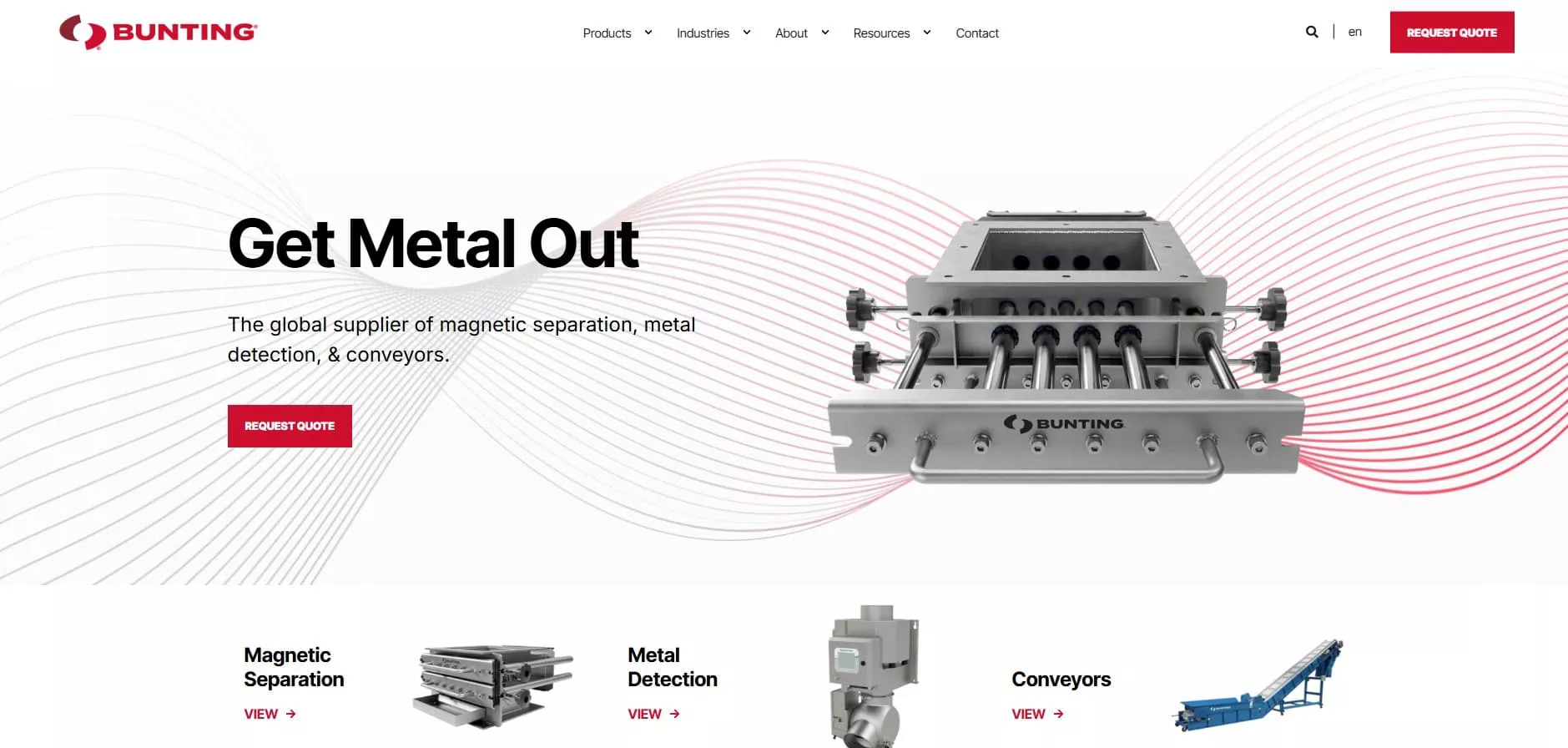
Company Overview: Founded in 1959, Bunting Magnetics has more than six decades of manufacturing experience in magnetic separation, metal detection, and material handling equipment. The company operates manufacturing facilities in the United States and the United Kingdom, while a consolidated factory-area figure is not publicly disclosed. Bunting is positioned as a diversified industrial magnetic equipment manufacturer serving recycling, food processing, plastics, feed and grain, pharmaceuticals, chemicals, and bulk-material industries. Its Magnetic Drum Separator range includes ferrite and rare-earth permanent drum designs, with radial-pole and alternating-pole configurations for continuous ferrous-metal removal. Bunting can provide standard equipment, custom magnetic configurations, housing options, conveyor integration, retrofit support, application engineering, and technical assistance.
Suitable Customer Groups: Recycling plants, plastics processors, food and grain processors, chemical manufacturers, bulk-material handlers, conveyor OEMs, and companies upgrading existing separation lines.
5. Metso
Founded: 1868 heritage; current Metso Corporation established through subsequent corporate development
Headquarters: Espoo, Finland
Main Magnetic Drum Separator Products: LIMS BSS, LIMS BSA, LIMS DS, LIMS CC/CR/CTC/DM Drum Separators
Company Overview: Metso traces its industrial heritage to 1868 and today operates as a global supplier of technologies, equipment, and services for aggregates, minerals processing, and metals refining. The company has a large international manufacturing and service network, although a single global factory-area figure for magnetic-separator production is not publicly disclosed. Metso is positioned toward large-scale industrial and mining applications, combining process engineering, equipment manufacturing, automation, and aftermarket services. Its LIMS portfolio is built around revolving magnetic drums with stationary internal magnetic arrays and includes dry and wet configurations for different material sizes and processing duties. Metso supports customers with process selection, equipment engineering, plant integration, commissioning, spare parts, maintenance, and lifecycle services.
Suitable Customer Groups: Iron ore mines, mineral beneficiation plants, dense-media separation plants, large mining companies, mineral-processing EPC contractors, and operators requiring high-capacity wet or dry magnetic separation.
6. Nippon Magnetics
Founded: 1943; Nippon Magnetics was established as a separate magnet business in 1983
Headquarters: Dazaifu, Fukuoka, Japan
Main Magnetic Drum Separator Products: EN/REN Drum Magnetic Separator, ENS/RENS Drum with Housing, EDS Electromagnet Drum Separator, HGMD Intensive Magnetic Force Drum
Company Overview: Nippon Magnetics traces its history to 1943, when Haramaki Iron Works was established, and began manufacturing magnetic products in 1947. The magnetic division became Nippon Magnetics in 1983, giving the company more than 40 years of dedicated experience under its current name and more than 70 years of magnetic-product manufacturing history. Its current headquarters and factory are located in Dazaifu, Fukuoka, with additional factories established in 2005 and 2010; the total manufacturing area is not publicly disclosed. The company specializes in permanent- and electromagnet-based separation equipment, with particular experience in fine-particle separation and customized magnetic applications. Its drum separator portfolio covers permanent, electromagnetic, housed, twin-pole, coolant, and intensive magnetic-force designs. Services include equipment selection, application engineering, customized manufacturing, technical consultation, and after-sales support.
Suitable Customer Groups: Recycling companies, steel producers, ceramic manufacturers, chemical processors, food manufacturers, powder-processing companies, mineral processors, and customers requiring specialized fine-particle magnetic separation.
7. IFE Aufbereitungstechnik
Founded: 1947
Headquarters: Waidhofen an der Ybbs, Austria
Main Magnetic Drum Separator Products: IFE Magnetic Drum Separator with Radial Magnetic Field, IFE Magnetic Drum Separator with Axial Magnetic Field, IFE Permanent Magnetic Drum Separator
Company Overview: IFE was founded in 1947 as an Institute for Technical Research and Development in Vienna, and its present headquarters and production site were established in Waidhofen/Ybbs in 1965. The company has more than 70 years of industrial experience and added magnetic separators to its product range in 1975. The exact production-area figure is not publicly disclosed. IFE is positioned as an engineering and production partner for bulk-material handling and processing, with magnetic separation as one of its established technology areas. Its Magnetic Drum Separators are designed around permanent magnets and can be configured with radial or axial magnetic fields according to the material and separation task. IFE provides application-specific engineering, equipment customization, technical consultation, production, installation support, and service.
Suitable Customer Groups: Mining companies, aggregate processors, recycling plants, bulk-material processors, waste-treatment facilities, foundries, and manufacturers requiring customized tramp-iron removal systems.
8. Multotec
Founded: 1973
Headquarters: Johannesburg, South Africa
Main Magnetic Drum Separator Products: Permax Wet Drum Magnetic Separator, SLS Permax Magnetic Separator, Low-Intensity Wet Drum Magnetic Separator, Medium-Intensity Wet Drum Magnetic Separator
Company Overview: Founded in South Africa in 1973, Multotec has more than 50 years of experience in mineral processing and operates across approximately 100 countries with more than 1,800 employees. The company maintains international manufacturing facilities and ISO-standard production capabilities, while a consolidated global factory-area figure is not publicly disclosed. Multotec is positioned as a mineral-processing equipment manufacturer with strong metallurgical engineering and application expertise. Its Magnetic Drum Separator strength is concentrated in wet-drum technology, particularly the Permax system developed for dense-media separation, magnetite recovery, ferrosilicon recovery, and mineral beneficiation. Multotec can provide metallurgical test work, process audits, equipment selection, customized engineering, plant optimization, field maintenance, spare parts, and technical support.
Suitable Customer Groups: Coal-processing plants, diamond mines, iron ore producers, dense-media separation plants, mineral beneficiation plants, mining EPC contractors, and large mineral-processing operations.
9. Dings Co. Magnetic Group
Founded: 1899
Headquarters: Milwaukee, Wisconsin, USA
Main Magnetic Drum Separator Products: Type PC Magnetic Drum Separator, Type FC Magnetic Drum Separator, Deep Draw Drum Magnetic Separator
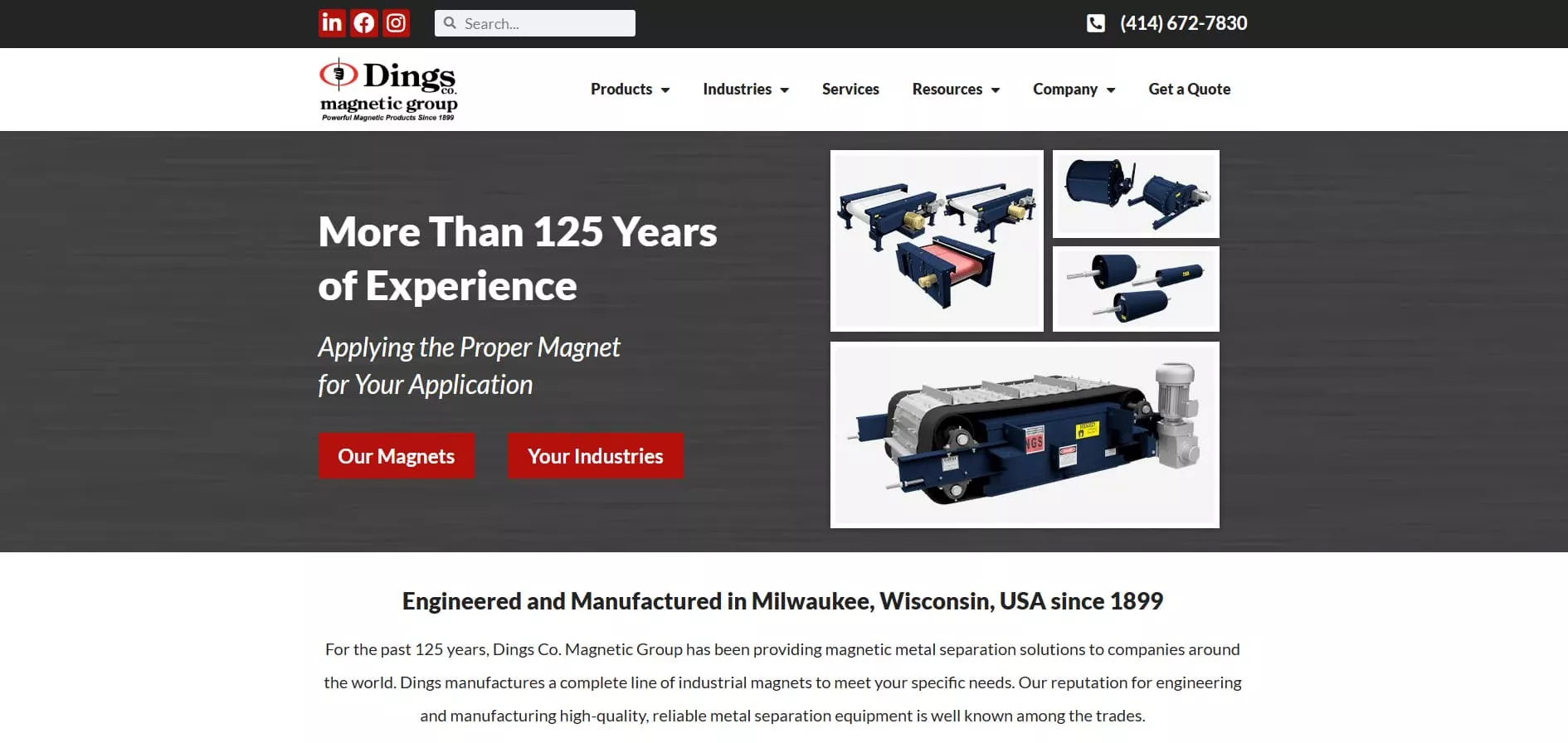
Company Overview: Founded in 1899 by Myron Dings, Dings has more than 125 years of experience in magnetic separation equipment manufacturing. The company is positioned as a specialized American magnetic-separation manufacturer serving recycling, foundry, aggregate, wood-processing, mining, and bulk-material applications. Its current manufacturing-area figure is not publicly disclosed. Dings' Magnetic Drum Separator technology is particularly distinguished by its patented Dings Flux Control (DFC) magnetic circuit, which is designed to produce a stronger, deeper, and more uniform magnetic field. The company offers standard and custom drum configurations, single- and multi-stage arrangements, housing options, application-specific magnetic circuits, and technical support for integrating drums into existing processing lines.
Suitable Customer Groups: Recycling plants, foundries, aggregate producers, mining companies, wood-processing facilities, municipal waste processors, scrap-metal recyclers, and bulk-material handling plants.
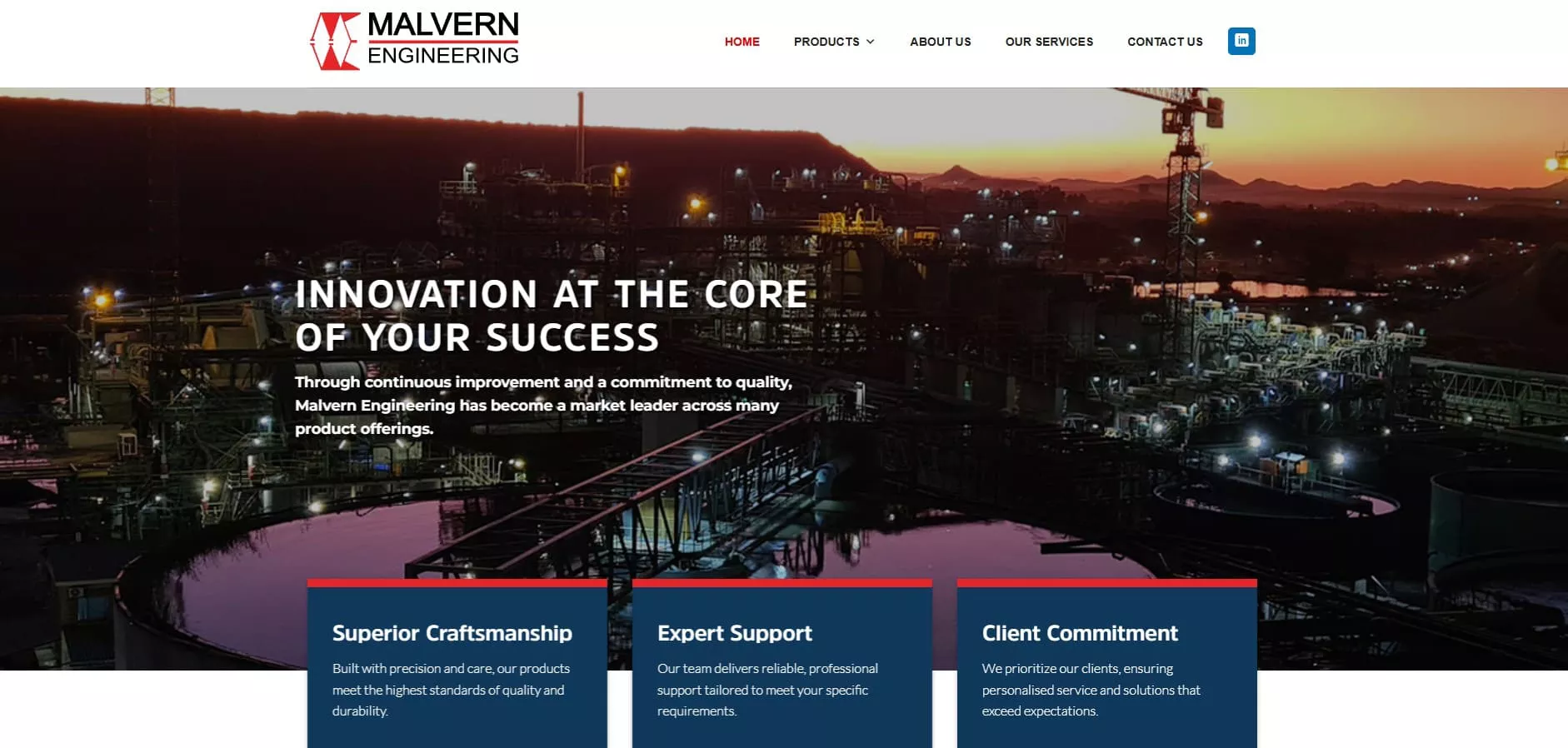
10. Malvern Engineering Works
Founded: June 1947
Headquarters: Germiston, Gauteng, South Africa
Main Magnetic Drum Separator Products: Permanent Magnetic Dry Drum Separator, Wet Low Intensity Magnetic Separator (WLIMS), Wet Medium Intensity Magnetic Separator (WMIMS), Heavy Media Drum
Company Overview: Malvern Engineering was established in June 1947 as a general engineering workshop serving South Africa's mining industry and has more than 75 years of engineering and manufacturing experience. The company operates from its head office and production facilities in Germiston, with an additional branch in eMalahleni; the total factory area is not publicly disclosed. Malvern is positioned as a specialist mineral-processing equipment manufacturer with a strong focus on magnetic separation and mining applications. Its Magnetic Drum Separator portfolio covers dry permanent drums and wet drum systems using ceramic or rare-earth magnetic circuits, with particular expertise in dense-media recovery and magnetic-ore concentration. The company provides equipment design, replacement-machine engineering, customized tanks, magnetic-circuit selection, application consultation, technical support, and maintenance assistance.
Suitable Customer Groups: Iron ore producers, coal-processing plants, manganese processors, dense-media separation plants, mineral beneficiation facilities, mining contractors, and customers replacing or upgrading existing magnetic separation equipment.
FAQs
1. Is a higher Gauss rating always better for a magnetic drum separator?
No. A higher Gauss value does not automatically mean better separation. Magnetic field strength must be considered together with magnetic field gradient, working distance, particle size, material layer thickness, drum speed, and the magnetic susceptibility of the target material. A very strong magnetic field can also reduce selectivity by capturing unwanted material in some applications. When comparing suppliers, do not compare surface Gauss alone. Ask for the magnetic field distribution, test conditions, working distance, target particle size, and expected recovery and purity under your actual operating conditions.
2. Should I choose a dry or wet magnetic drum separator?
Choose according to the physical condition of your feed material and the separation objective. Dry Magnetic Drum Separators are generally suitable for dry bulk materials such as recycled materials, aggregates, powders, and dry mineral streams. Wet drum designs are more appropriate when the feed is a slurry, such as magnetite processing, dense-media recovery, or other wet mineral-processing applications. For wet systems, you should also evaluate slurry density, particle size, water flow, tank configuration, and the required recovery and concentrate grade. Using a dry drum for a wet slurry application, or forcing a wet drum into a dry process, can result in unstable feeding and poor separation performance.
3. Why is my magnetic drum separator not removing enough iron or magnetic material?
Poor separation does not necessarily mean that the magnet is too weak. First check whether the feed layer has become too thick, whether material is being fed unevenly, whether the working distance has increased, whether the drum speed has changed, or whether magnetic material has built up on the drum surface. You should also check whether the target particles are sufficiently liberated and magnetically responsive. Compare the current operating conditions with the original commissioning conditions before changing the magnetic circuit. Increasing magnetic strength without identifying the actual cause may not solve the problem. A systematic check of feed condition, working distance, speed, buildup, installation, and target material is usually a better first step.
4. How can I improve magnetic recovery without reducing product purity?
Recovery and purity should be optimized together rather than maximizing magnetic attraction alone. Start by controlling feed thickness and distribution so that magnetic particles are exposed to the effective magnetic field. Then optimize drum speed, magnetic arc, working distance, feed rate, and splitter position according to the material characteristics. For wet applications, slurry density, flow rate, tank configuration, and water conditions also need to be controlled. If the required recovery and purity cannot be achieved in a single stage, ask the manufacturer whether rougher, cleaner, or scavenger stages are appropriate. Always evaluate performance using actual recovery and product-grade data rather than magnetic strength alone.
5. What causes a magnetic drum separator to wear out or require frequent maintenance?
Heavy abrasive materials, incorrect feeding, excessive loading, slurry leakage, poor sealing, bearing problems, and insufficient wear protection can all shorten equipment life. For mining, aggregate, slag, and other abrasive applications, ask the manufacturer about drum-shell material, shell thickness, wear liners, bearing protection, shaft design, sealing, and replacement procedures before purchasing. Establish a preventive-maintenance schedule covering bearings, drive components, drum surfaces, seals, discharge areas, and wear parts. It is also important to keep spare parts available for critical components because an inexpensive spare part can prevent a much more expensive production shutdown.
Conclusion
Selecting the right magnetic drum separator manufacturer is essential for ensuring continuous, high-efficiency ferrous separation in your plant. By evaluating manufacturers based on their magnetic technology, wet/dry capabilities, and custom engineering, you can avoid costly procurement mistakes. Use this technical guide and our buyer's checklist to streamline your sourcing process and secure the optimal magnetic separation equipment for your facility.
